Class 12 English Lesson 3 Deep Water
Class 12 English Lesson 3 Deep Water
Deep Water NCERT Solution
Short Answer Questions
Q1. How does Douglas make clear to the reader the sense of panic that gripped him as he almost drowned? Describe the details that have made the description vivid.
Ans. William describes his experience where he had a close brush with death at the Y.M.C.A. Swimming pool. As it a first-person account, he has described it deeply. The emotional, mental and physical struggle and the paralyzing fear of drowning have been discussed in detail. William retained his intelligence and had a plan to come to the surface. He tried it but I did not work and after a few trials to save his life, death dawned upon him. All these details make the description vivid.
Q2. How did Douglas overcome his fear of water?
Ans. William Douglas was not able to come out of his fear. So, he hired a swimming instructor. Once he had learned swimming, he wanted to check if he had overcome the fear as well. He would swim in lakes and found the fear to return in small phases. William was no longer scared as he knew that he could swim. Hence, he overcame the fear.
Q3. Why does Douglas as an adult recount a childhood experience of terror and his conquering of it? What larger meaning does he draw from this experience?
Ans. William Douglas gives a detailed description of his childhood experience so that the reader gets familiar with the kind of fear that he had as a child. When he quotes Roosevelt ““All we have to fear is fear itself” he tries to draw a larger meaning from this experience. He wants to highlight the fact that life became meaningful and the desire to live grew intense once he had conquered his fear.
Extract Based Questions
Extract-based questions are of the multiple-choice variety, and students must select the correct option for each question by carefully reading the passage.
A. My breath was gone. I was frightened. Father laughed, but there was terror in my heart at the overpowering force of the waves. My introduction to the Y.M.CA. swimming pool revived unpleasant memories and stirred childish fears. But in a little while I gathered confidence. I paddled with my new water wings, watching the other boys and trying to learn by aping them. I did this two or three times on different days and was just beginning to feel at ease in the water when the misadventure happened. (CBSE QB, 2021)
1. Choose the correct option with reference to the two statements given below
Statement 1: The author’s father laughed to mock his son’s inability to swim.
Statement 2: The author wanted to swim just to prove to his father that he can swim.
A) Statement 1 is true but Statement 2 is false.
B) Statement 1 is false but Statement 2 is true.
C) Both Statement 1 and Statement 2 cannot be inferred.
D) Both Statement 1 and Statement 2 can be inferred.
Ans. C) Both Statement 1 and Statement 2 cannot be inferred.
2. “My introduction to the Y.M.CA. swimming pool revived unpleasant memories and stirred childish fears.” It can be inferred that this was a clear case of
A) suppression
B) oppression
C) depression
D) repression
Ans. D) repression
3. The misadventure that took place right after the author felt comfortable was that
A) the author slipped and fell into the swimming pool.
B) a bully tossed him into the pool for the sake of fun.
C) his coach forgot to teach him how to handle deep water.
D) his father couldn’t help him from drowning into the water
Ans. B) a bully tossed him into the pool for the sake of fun.
4. Choose the option that describes the equipment used by the author while learning to swim.
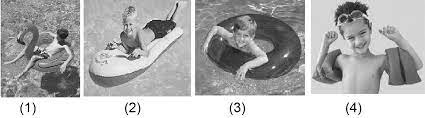
A) Option 1
B) Option 2
C) Option 3
D) Option 4
Ans. D) Option 4
B. It was only two or three feet deep at the shallow end; and while it was nine feet deep at the other, the drop was gradual. I got a pair of water wings and went to the pool. I hated to walk naked into it and show my skinny legs. But I subdued my pride and did it.
1. The author subdued his pride and did it. This shows that he –
A. Hated swimming
B. Loved swimming
C. did not want to swim
D. Was forced to swim
Ans. B Loved swimming
2. What are water wings?
A. A pair of wings to fly over the water
B. A pair of life saving tube to swim in water
C. both a and b
D. None of these
Ans. B. A pair of life saving tube to swim in water
3. He got water wings before going to the pool. This shows that he –
A Was brave
B. Was courageous
C. was rich
D. Was scared
Ans. D. Was scared
4. State true or False –
The writer could drown at the shallow end of the pool
Ans. False
5. Find a synonym of overpower
Ans. Subdue
C. Then all effort ceased. I relaxed. Even my legs felt limp; and a blackness swept over my brain. It wiped out fear; it wiped out terror. There was no more panic. It was quiet and peaceful. Nothing to be afraid of. This is nice… to be drowsy… to go to sleep… no need to jump… too tired to jump… it’s nice to be carried gently… to float along in space… tender arms around me… tender arms like Mother’s… now I must go to sleep… I crossed to oblivion, and the curtain of life fell. (CBSE QB, 2021)
1. Choose the correct option with reference to the two statements given below.
Statement 1: The author tried his best to jump out of water.
Statement 2: After a while, the author was not anxious in water.
A) If Statement 1 is the cause, Statement 2 is the effect.
B) If Statement 1 is the effect, Statement 2 is the cause.
C) Both the statements are the effects of a common cause.
D) Both the statements are the effects of independent causes.
Ans. A) If Statement 1 is the cause, Statement 2 is the effect.
2. The ‘curtain (of life) fell’ corresponds to an aspect of
A) Geometry.
B) History.
C) Sports.
D) Drama
Ans.D) Drama
3. The purpose of using “…” in the above passage is to
A) show omission.
B) indicate pauses.
C) shorten a dialogue.
D) replace an idea.
Ans. B) indicate pauses.
4. Which option indicates that the poet lost consciousness?
A) ‘It was quiet and peaceful.’
B) ‘I crossed to oblivion.’
C) ‘Tender arms like Mother’s.’
D) ‘It wiped out fear.’
Ans. B) ‘I crossed to oblivion.’
D. But I was not finished. I still wondered if I would be terror-stricken when I was alone in the pool. I tried it. I swam the length up and down. Tiny vestiges of the old terror would return. But now I could frown and say to that terror, “Trying to scare me, eh? Well, here’s to you! Look!” And off I’d go for another length of the pool.
1. Find a synonym of trace
Ans. Vestige
2. Did the narrator actually speak to the terror?
Ans. No, he said this in his mind.
3. What quality can be seen in the author?
A Courage
B Terror
C fear
D All of these
Ans. A Courage
E. I laughed and said, “Well, Mr. Terror, what do you think you can do to me?” It fled and I swam on. (CBSE SQP 2019-20)
1. Who is ‘I’ here? Who is being addressed to as Mr. Terror?
Ans. ‘I’ here is the writer William Douglas. The fear is being addressed as Mr Terror
2. Why has Mr. Terror been addressed so?
Ans. It is the same terror that he has experienced earlier also. So, he calls it Mr Terror
3. Why did the narrator laugh?.
Ans. He laughed because he had overcome the terror
4. Why did Mr. Terror leave?
Ans. Mr. Terror had to leave because the writer was not scared by it.
Long Answer Questions
Q1. “There was terror in my heart at the overpowering force of the waves.” When did Douglas start fearing water? Which experience had further strengthened its hold on his mind and personality?
Ans. Douglas had been knocked down by the waves at a California beach when he was three or four years old. The waves swept over him, burying him beneath them. Water’s overwhelming power terrified him, and he developed an aversion to it. When Douglas was eleven years old, his aversion to water reappeared and strengthened its grip on his mind and personality. Douglas was thrown into the deep end of the pool by an eighteen-year-old boy. For the second time, the descent into water was a terrifying experience. His legs were almost paralyzed, his lungs hurt, his head throbbed, and he felt like he was suffocating.
Keeping his cool, he pushed himself to the surface of the pool, but his efforts were in vain. When he regained consciousness, he was lying on his stomach beside the pool. Now the haunting fear of water gripped his heart, and he was mortally afraid of water for a long time.
Q2. A big boy threw Douglas into the swimming pool. How did this experience affect Douglas?
Ans. William Douglas had decided to overcome his childhood fear of water and joined the Y.M.C.A swimming pool. He had gradually gained confidence and was attempting to learn to swim by imitating other boys and using water wings. The misadventure occurred just as he was beginning to relax.A big boy, about eighteen years old, saw Douglas sitting by the pool and threw him into the deep end. Douglas was terrified, but he did not lose his mind. He planned on giving himself a thrust just as he touched the bottom, then rising to the surface of the water and floating towards the edge.
His plans fell through, and he went up and down in the water three times, unable to reach the surface and breathe. When he was rescued, he had almost given up. The youngster admitted that he was merely ‘fooling’.
Q3. We always admire those heroes who face challenges bravely in different phases of life and emerge successfully. Elaborate on this statement with reference to William Douglas.
Ans. Determination and perseverance are a set of characteristics and abilities that motivate people to set goals for themselves and then take action to achieve those goals. Douglas was able to overcome his fear of water by focusing on the values of positivity and courage. He was initially afraid of water, but his tenacity and determination led him to seek out an instructor and overcome his apprehension. Today’s determination leads to tomorrow’s success. It is that innate quality in our soul that comes to the surface when something irritates it. It reflects the values instilled in us by society and circumstance and enables us to overcome all obstacles.
There is always reverence for heroes like William Douglas who face challenges bravely and eventually triumph. For years, he was plagued by a fear of water. It took away his enjoyment of canoeing, swimming, fishing, and boating. Douglas was able to overcome his fear thanks to deliberate, planned, and consistent efforts. He was dead set on overcoming his fear, and it was only through his perseverance and tenacity that he triumphed.
Q4. With the help of courage one can achieve a lot. How did Douglas overcome his fear of water?
Ans. Douglas was terrified of water from a young age. His mishap at the YMCA pool exacerbated his fear of water. He was unable to participate in fishing and boating trips. He finally decided that he had to overcome his fear. He couldn’t do it without professional assistance, so he hired a coach who gradually turned him into an excellent swimmer. Douglas was still unsatisfied. He took advantage of every opportunity to swim and dive in water, thereby confronting his fear. He was able to completely overcome his fear, prompting him to state that what one is afraid of is fear itself, and that if we can overcome that fear, we can achieve anything in life.
Q5. Douglas fully realized the truth of Roosevelt’s statement, “All we have to fear is fear itself.” How did this realization help him brush aside his fear and become an expert swimmer?
Ans. Fear is a crippling emotion. It limits all kinds of efforts, creativity, and ventures that one might consider. Fear, however, can be overcome with grit, determination, and hard work. This was demonstrated by William Douglas. He overcame his fear of water by first psychoanalyzing it and then treating it methodically. Douglas has developed hydrophobia as a result of his misadventure at the YMCA pool. Regardless, he hired a professional trainer and learned to swim step by step. Douglas was made a swimmer by the trainer due to his strong willpower and rigorous practice.
Douglas, however, was not satisfied and set a higher standard for his perfection, devising various tests and situations to overcome fear in all forms. As a result, Douglas was eventually able to overcome his fear of water and become an expert swimmer.
Q6. Desire, determination and diligence lead to success. Explain the value of these qualities in the light of Douglas’ experience in “Deep Water”.
Ans. Determination and perseverance are a set of characteristics and abilities that motivate people to set goals for themselves and then take action to achieve those goals. Douglas was able to overcome his fear of water by focusing on the values of positivity and courage. He was initially afraid of water, but his tenacity and determination led him to seek out an instructor and overcome his apprehension. Today’s determination leads to tomorrow’s success. It is that innate quality in our soul that comes to the surface when something irritates it. It reflects the values instilled in us by society and circumstance and enables us to overcome all obstacles.
There is always admiration for heroes like William Douglas who face challenges bravely and eventually triumph. For years, he was plagued by a fear of water. It took away his enjoyment of canoeing, swimming, fishing, and boating. Douglas was able to overcome his fear thanks to deliberate, planned, and consistent efforts. He was dead set on overcoming his fear, and it was only through his perseverance and tenacity that he triumphed.
Q7. Describe the efforts made by Douglas to save himself from drowning in the YMCA swimming pool.
Ans. Douglas was dragged into the deep end of the YMCA swimming pool. Those nine feet seemed a long way down at the time. As soon as his feet touched the ground, he gathered all of his strength and sprung upward. He slowly arose, opened his eyes, and saw only water. He reached up as if for a rope, but his hands only clutched at water. He flailed at the water’s surface, swallowed, and choked. He attempted to raise his legs, but they hung as if paralyzed. He began his journey back to the pool’s bottom once more.
Then he remembered the plan: he would spring from the bottom of the pool and float to the surface like a cork. He’d lie flat on the water and thrash around with his arms and legs. Then he’d get to the pool’s edge and be safe. The jump made no difference yet again, and Douglas eventually gave up and relaxed as blockness swept over his brain.
Q8. Courage and optimism are attributes that can make the impossible possible. Elucidate with reference to Deep Water.
Ans. Man has only succeeded in making the impossible possible through courage, desire, and determination. The best example is William Douglas’ struggle to overcome his fear of water. Douglas developed a fear of water as a result of his near-drowning experience at the Y.M.C.A. swimming pool. Panic attacks paralyzed his lumps the moment he entered the water. He had lived for many years with this fear. But, in the end, he decided to overcome his fear and was successful due to his perseverance and positive attitude. He hired a swimming instructor, who transformed him into a swimmer through rigorous training and special technique. Douglas had to overcome this fear for nearly seven months.
But, in the end, Douglas demonstrated that it was courage, determination, desire, diligence, and optimism that enabled him to overcome his fear.
Q9. How did the instructor make Douglas a good swimmer?
Ans. The instructor worked hard to ‘build a swimmer’ out of Douglas. He recognised Douglas’s deathly fear of water and practiced with him five days a week for an hour each day. He devised a novel method of teaching him to swim. He fastened a rope to Douglas’ belt, which passed through a pulley that ran over an overhead cable. He made Douglas move back and forth in the pool while holding the end of the rope in his hand, without causing him much fear. Douglas was taught how to exhale underwater and inhale by raising his nose.
This exercise was repeated several times, and they swam across the pool week after week. Douglas was then taught to kick with his legs by the instructor. His legs did not work at first, but he was eventually able to control and command them. Finally, his instructor transformed him into a near-perfect swimmer.
Q10. ‘This handicap stayed with me as the years rolled by.’ Which handicap is being referred to and what are the events that made Douglas handicapped?
Ans. The handicap in question is Douglas’s fear of water, which he developed as a result of some unfortunate events in his childhood. As a result, he was unable to participate in watersports or swim. His father took him to the beach in California when he was three or four years old. Douglas was knocked down by the sea waves and nearly drowned. He developed a phobia of water. Furthermore, when he was ten or eleven years old, a thug threw him into a swimming pool. He had a terrible experience at the time. He was almost submerged in water, which suffocated him and paralyzed his limbs. He did, however, avoid drowning.
Since then, he has been afraid of water and has been unable to enjoy activities such as canoeing, swimming, rafting, fishing, and so on. This became a disadvantage for him because he was deprived of the enjoyment of water sports and swimming.
Q11. The prose selections, Deep Water and Indigo, bring out the importance of overcoming fear, in order to be able to lead our lives successfully. Imagine yourself to be a motivational speaker who has to address high school students. Write this address in 120 – 150 words elaborating on occurrences from the two texts to inspire your audience and to convince them about the importance of overcoming fear.
Ans. Good day, students! We’ve all experienced being afraid. Fear is our body’s natural reaction to an impending threat or danger. But when fear takes over our lives and prevents us from reaching our goals, it’s time to take action and overcome it. This message is conveyed in the prose selections Deep Water and Indigo. Deep Water depicts the protagonist overcoming their fear of water and learning to swim in the face of danger and uncertainty. This demonstrates that overcoming our fears allows us to open ourselves up to new experiences and opportunities. Similarly, in Indigo, the protagonist must overcome their fear of being different and embrace their uniqueness in order to live a happy life.
This teaches us that facing our fears allows us to not only be true to ourselves, but also live an authentic and meaningful life. So, students, I encourage you to face your fears and embrace the challenges that come your way. Overcoming fear will not only make you stronger, but it will also help you live a more successful and fulfilling life. Remember that the only thing to be afraid of is fear itself. So, go out there and live your lives to the fullest!
Thank you.
Q12. The story Deep Water talks about Douglas’ attempts to overcome his fear of water. The story can also be viewed as a figurative manifestation of life’s many challenges. Elaborate with reference to the text.
Ans. The story “Deep Water” can be interpreted as a metaphor for life’s many challenges, as discussed further below. Since his childhood, William Douglas has had a fear of water. He overcame his fear through sheer determination. To overcome his fear, he eventually hired an instructor, whose instruction and practice relieved him of his anxiety. He was terrified and frozen when he went underwater, but his determination to succeed helped him. The deep-water metaphor refers not only to a fear of water, but also to human fear of all challenges in life. The adjective ‘deep’ refers to the fear’s intricate nature and how hidden its mysteries are.
Every challenge in life is terrifying, and only a determined person can break free from the fears that have encircled the challenges. The struggle and journey to overcome fears is prolonged.
Q13. The childhood experience of terror of Douglas made him stronger and more determined. Elucidate the above statement supporting it with evidence from the text.
Ans. It is true; if the childhood mishaps had not occurred, Douglas would never have become stronger and more determined. The terrifying incident at the YMCA pool, in which he nearly drowned, instilled in him a deep fear of water. All of his outings with his friends were ruined by his fear. Whenever he went to Cascades, Tieton, or Warm Lake with his friends, he was overcome with fear of water, his legs paralysed, and icy horror gripped his heart.
Finally, in October, he hired a swimming instructor. The instructor fastened a belt around his waist. He wrapped the belt around himself. He fastened the belt to an overhead cable.
He clung to the rope as the author attempted to swim back and forth across the pool for hours, days, and weeks. It took the author three months to learn the fundamentals. The instructor then showed him how to exhale underwater and inhale by raising his nose. He then showed him how to kick water with his legs.
He asked the author to swim the length of the pool after teaching and perfecting the basics. The author swam the length of the pool by himself starting the next day. There was no turning back after that. He swam across Wentworth and Warmlake Lakes. That is how the author overcame his apprehension.He emerged stronger and more determined.
Board Questions
Q1: Answer the following question in 120 – 150 words: (10)
Q1: Answer the following question in 120 – 150 words: (10)
How did Douglas develop an aversion to water?
OR
Q2: Answer the following question in 120 – 150 words: (6)
What happened at the YMCA swimming pool which instilled fear of water in Douglas’ mind?
Ans. Since the age of three or four, when the author accompanied his father to the beach, he realized that he disliked water. He would get frightened by the power of the waves which threw him, swept over and he was buried in water.
Later, at the age of ten – eleven years, he decided to learn swimming. He joined swimming classes at a swimming pool at the Y.M.C.A. He felt that the swimming pool was safe. Also, the pair of water wings would help him stay on the surface but more, they instilled a sense of confidence in him. It was just when he had started feeling comfortable that an incident took place. A big boy picked up the author and threw him in the pool at the deep end. He got water in his mouth and sank to the bottom. He was frightened but kept his mind working and devised a way out but things did not turn out as planned. His lungs felt as if they would burst, he was overpowered by fear, reached out, as if to grab something, but could only get his hands on the water. He got suffocated due to lack of air, could not scream, moved his arms desperately but all his efforts failed and he once again sank to the bottom of the pool. An unexplainable terror seized him. His limbs were lifeless, rigid due to fear and he could not even scream, the only sign of life was his heart beat. He sucked in water and then suddenly all his efforts to save himself stopped. He was relaxed, peaceful, fearless and sleepy, almost dead.
It was due to these experiences that the author developed an aversion to water.
Q3: Answer in 30 – 40 words: (2)
How did the instructor turn Douglas into a swimmer?
Ans. The instructor made him practice swimming step by step and gradually, piece by piece, turned him into a swimmer. When he had perfected each piece, he put them together into an integrated whole.
Q4: Answer the following question in 120 – 150 words: (6)
Describe the efforts made by Douglas to overcome his fear of water.
Ans. Douglas was in the tight grip of a fear of swimming in water bodies and finally decided to get rid of it. He hired an instructor who taught him swimming piece by piece and when he had learnt it all, he combined all the pieces together and made Douglas a swimmer. Still, he was not confident, and the terror would seize him time and again. Douglas wanted to get rid of all the fear, he wanted to conquer it. So, he went to various lakes, dived and swam across them. He reverted sarcastically to the tiny vestiges of fear that would grip him time and again until all of it vanished away. Douglas realized that fear was merely a crop of the mind and once he had conquered it, he felt released, free to walk arduous terrains, climb peaks and brush aside fear. Douglas had faced stark terror and then by conquering it his desire to live life grew intensely.
Q5: Answer the following question in 30 – 40 words: (2)
How did his experience at the YMCA swimming pool affect Douglas?
Ans: Douglas’ experience of drowning and almost being dead instilled a fear of water in him. He shook and cried, couldn’t eat, for days a haunting fear engulfed him, the slightest exertion upset him. He never went back to the pool, feared water and avoided it whenever he could.
Comments
Post a Comment